
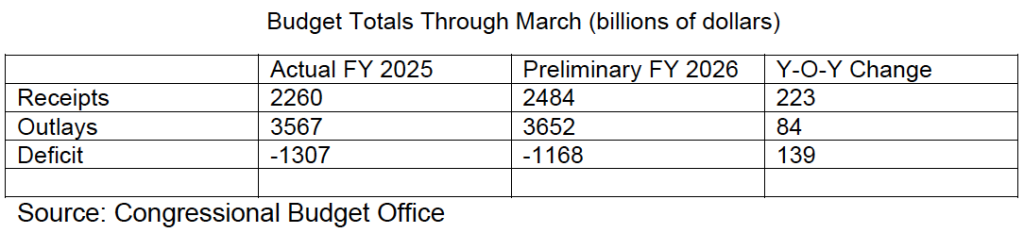
Amidst the furor over the Middle East conflict, the administration’s release of its budget proposal for fiscal year 2026-27 attracted little attention. While these initial submissions generally serve only as a starting point for Congressional struggles over the final budget and often highlight a political wish list for or against certain spending which no one expects to be included in the final output, the broad fiscal implications nevertheless stand out. The Office of Management and Budget, the executive branch’s agency for fiscal matters, projects $2 trillion annual deficits for the next three years, bringing the federal debt held by the public (that is, not assigned to any of the various federal trust funds) to about $38 trillion by the end of fiscal year 2028. We should note that OMB projections tend to be optimistic about deficits, but even taken at face value, this is an enormous number and has begun to concern some people in Washington and New York who are still willing and able do math. But, as the saying goes, never let a good crisis go to waste, and recent throat-clearing by soi-disant responsible bankers and financial commentators has given us a glimpse of future moves which could be seized upon.
As we mentioned last month, the Social Security Trust Fund is currently scheduled to become exhausted in 2032, and the downward trajectory of its balance will become unmistakable by the next scheduled presidential election. Of course, higher taxes or benefit cuts are unpopular, so it is difficult to see how any proposals to “save” Social Security by doing either or both will be seriously contemplated in 2028. In normal times, there would have been an opportunity after the mid-term elections in 2027 to ram through unpopular policy, especially with a second-term president—but these are not normal times. And so we are likely to arrive in 2029, with a mere two year window to avoid statutory benefit cuts (when the SSTF reaches zero, benefits can only be paid out with incoming payroll taxes, which at that point will amount to about two-thirds to three-quarters of the outflows.)
The obvious and easiest solution to the problem is simply to deposit $1 trillion in the SSTF. As we have pointed out many times, does it much matter if the accumulated deficit is $38 or $39 trillion? But despite Washington’s reputation for seeking the easy way out, this proposal has not garnered any serious attention as far as we are aware. We would not wish to speculate on the reasons for the avoidance of what would seem to be a popular and practical solution other than to say that it surely could not stem from a genuine impulse towards fiscal discipline on the part of policymakers, given their proclivities in regard to other parts of the budget.
So odds are the federal government will arrive in 2029 having taken no steps towards avoiding the benefit-cut cliff (perhaps someone will start a prediction market contract for it) . At that point, a commission (no doubt a “blue-ribbon” commission) will be appointed, composed of serious economists and financiers who will propose a gussied-up form of payroll tax increases and benefit cuts as a painful but unfortunately unavoidable solution. But of course, it may dawn on some influential podcaster that the bad news is completely avoidable by the simple expedient we have suggested. This way out may even shift into the Overton window given the extreme political stress arising from the bad news.
It is this outcome which the aforementioned financial powers-that-be wish to forestall. No doubt their attempts to bludgeon the American people into accepting an unnecessary hit will require the return of the Bond Vigilantes. These semi-mythical raiders attack using sudden spikes in interest rates and employing the rhetoric of grim financial necessity No group has more useful than they for explaining to the American middle-class why they can’t have the things they were promised.
The outlines of the rhetorical gambit for getting Americans to accept a “fix” for Social Security which includes a higher payroll tax rate and curs to benefits are becoming clearer. This commentary would like to reiterate that those arguments are hypocritical nonsense even as we await the pale riders.
All performance referenced is historical and is no guarantee of future results. All indices are unmanaged and may not be invested into directly. All performance referenced is historical and is no guarantee of future results.
The opinions voiced in this material are for general information only and are not intended to provide specific advice or recommendations for any individual.
The content is developed from sources believed to be providing accurate information.
Securities offered through LPL Financial, member FINRA/SIPC. Investment advice offered through Great Valley Advisor Group, a Registered Investment Advisor. Great Valley Advisor Group and Doylestown Wealth Management, Inc. are separate entities from LPL Financial.